A TTRPG is a tabletop roleplaying game where people create a narrative guided by rules. There are characters, worlds, and narratives that can run for one session all the way to multi-year epics. Usually, there are dice and cards involved, nudging the action along and introducing surprising twists and complications; games can be played both solo or groups of people. All that puts TTRPGs in a space between boardgames and video games.
This guide is for new players, curious readers, and first-time gamemasters (GMs) and will cover many of the basics to get started in this brilliant hobby.
What Is a TTRPG?
TTRPG stands for tabletop roleplaying game, though some people cut that down to just roleplaying games (RPGs).
One of the things I love about this hobby is the sheer variety of games on offer. Settings cover everything from fantasy, historical, present-day, alternative history/reality, cyberpunk, post-apocalypse, and sci-fi. Likewise, player characters (PCs) can be noble heroes, morally grey protagonists, gritty anti-heroes, or outright villains; they may even be no one special in the wrong place at the right time.
This bonkers-crazy range comes from the fact all TTRPGs leverage players’ imagination. The rules both suggest limits for what’s possible and encourage doing cool things. This is why so many people say if you can imagine it, your character can do [almost] anything. However, limits are important; playing a game with all the cheats on gets boring quickly.
Similarly, working through a story where the beginning, middle, and end are already fixed suits authors, not gamers. A huge part of the appeal of TTRPGs is the unexpected and improvised actions that feed events.
This is why dice, sometimes cards, are such a staple in the hobby. They add in the randomness that delivers a narrative unforeseen consequences or turns a combat situation on its head.
How a TTRPG Session Works
The variety in the hobby goes well beyond setting. Both the vibe at the table and how loose or complex the rules are can wildly differ to match preferences. However, generally the flow of a game runs in a loop:
1) Set up an interesting situation in the game world. For instance, this might be walking into a bar as a fight breaks out; or, it may involve trying to talk down a villain from ending the world.
In group games, like Draw Steel, GMs usually handle this. There are popular GM-less games too, like Fiasco where players take turns or it’s a combined effort. Solo games work a little differently, which I’ll come to in a bit.
2) In response to the interesting situation, the players choose what their characters try to do. For example, they may try to break up the bar fight, join in, avoid confrontation altogether, or something else. Unlike in video or boardgames, PCs’ actions are only really restricted by players’ imaginations and what everyone involved finds fun.
Whether PC actions succeed or fail depends on the rules of the game. Some actions will automatically succeed. Others may need a decider; that might involve the GM choosing a result, or a roll of the dice randomising one. This is what makes TTRPGs so unique as a gaming experience; it’s this randomness that means no session runs like any other.
3) In reaction to the PCs’ attempts, the world changes. In effect, this is a new situation, one that has evolved through the players’ choices; we’re back to the beginning of the loop.
For Players
Players are in control of one or more characters. There’s a huge amount of advice—some more forceful than others—on just how to play those characters. Basically, it comes down to one simple rule:
Do what’s fun for you as long as it doesn’t hurt the fun of anyone else in the game.
For some players, that’s creating a voice and diving into what they imagine to be the mind of another person. For others, characters are personal avatars: direct representations of what they’d like to do in fictional situations. And for some others, characters are tools for solving problems or making the narrative more exciting.
Don’t be overwhelmed by this. The truth is most people blend two or all of these, and can vary moment to moment. There certainly is no one true way to play beyond the golden rule. Experiment. Find what you enjoy. And, if it doesn’t negatively affect others playing your game, run with it.
For GMs (If There Is One)
I’m using the universal term GM but actually the precise name varies from system to system. Dungeon Master, Keeper, Director, Storyteller, Warden, Marshal, and Game Mother (Alien: The RPG) hint at the variety of vibes available. In practice, there’s no difference; the role is the same.
GMs, from one perspective, do exactly the same thing as the players, but on a bigger scale. That means following the same golden rule, too.
While players are only controlling one or a few characters, the GM is making decisions for everyone else. That includes NPCs, creatures, and the environment. Essentially, the world is their character, broken down into sub-parts. While the players decide how the PCs respond to the world, the GM decides how the world reacts to them.
The GM is not the players’ opponent. The objective is to challenge the players and give them chances to have fun. That means their characters have opportunities to do really cool or dramatic stuff.
It definitely does not mean crushing the PCs like bugs. The GM has the entire world at their control. It’s not a fair fight on any level. It’s also not going to promote long-term play. Players suffering under a GM that smashes their characters without mercy will find a new GM. GMs that have the world react in ways that do not respect player choices will find themselves alone even faster.
Learning to let control go of outcomes is one of the most important skills for a GM. They set up situations. It’s the players and dice rolls that determine what happens next. Then, the loop repeats.
Dice in TTRPGs

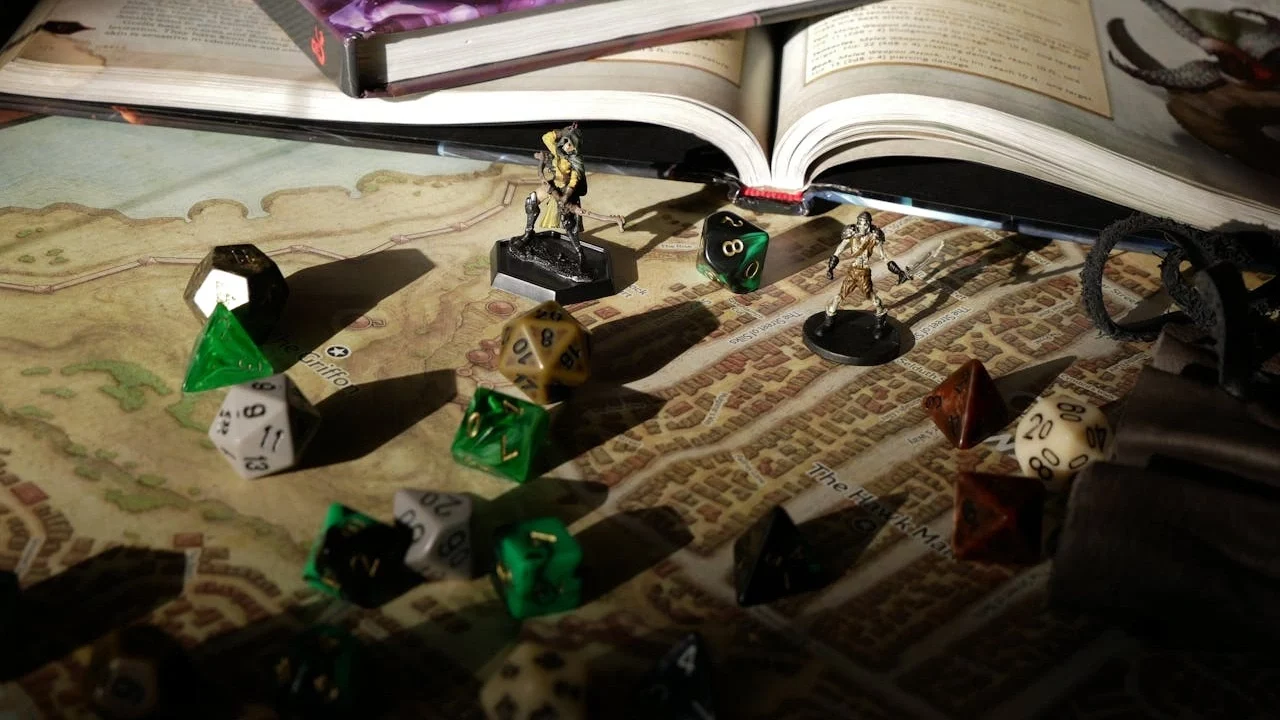
Which particular dice get rolled will depend on the system. Dungeons & Dragons (D&D), the most popular roleplaying game, primarily uses a d20. However, other games use two d10s, or a handful of d6s to decide results.
Most systems are roll high. For instance, if the GM decides a task is quite difficult, they may challenge players to roll above 15. This is called the task’s difficulty class (DC), target number (TN), or other similar term. The players who have characters attempting the task each roll a d20; any result of 16-20 succeeds. Other systems, like Symbaroum, are roll low, while others require combinations, like Hollowpoint, to succeed.
Whichever the case, success or failure, the situation changes. For instance, in the bar fight, a PC throws a punch; on a success they may knock out their opponent; failing results in the opponent attacking back more savagely. This sets up the player with an evolving situation and keeps both the narrative and the action flowing.
Maps and Miniatures
There are many wonderful map makers, token artists, and miniature sculptors. Cze & Peku, Miska’s Maps, Forgotten Realms, Techlanders, and Hero Forge are just of the incredible talent out there. None of their work is necessary for a game, but they can be very useful. And cool. Very, very cool (author’s weakness on show).
Maps, tokens, and miniatures are a quick way for everyone to understand the situation; distances to NPCs, cover locations, and areas of effect for explosions can be easily referenced. Having GMed a player with aphantasia, maps were indispensable for that group. They are a shortcut, speeding up scene set-up and reducing confusion.
However, other groups prefer “theatre of the mind” (TotM) gameplay. No visual props beyond a scene-setting picture, if even that. TotM can speed up gameplay, encourage more creativity, and handle scene changes a static map cannot account for.
As with styles of play, there is no one true way. Again, it’s been my experience tables actually use both styles in one session. So, my advice is the same: experiment and find what works for you.
One-Shots, Short Adventures, and TTRPG Campaigns
There are three main ways to experience the hobby.
The first is through a one-shot. These are single-session games that are usually over within two to three hours of play. The narrative needs little to no preparation on the players’ part, and there are no lasting implications. Once the game is done, the group are free to start something new.
A short adventure is the next step up. This may be four to eight sessions. For a little more commitment, the group can play out a more developed narrative or tackle more complicated challenges. As an aside, it’s also a good way to properly test-run a new system to see if it’s to your liking.
Long campaigns are the other choice. Many people dream of going through a multi-year campaign, but far fewer actually finish one. It’s the chance to see characters develop through truly epic storylines, and fully appreciate their impact on the world. It’s also by far the most vulnerable to the final boss of TTRPGs: scheduling.
People’s real-life situations change; they get new commitments, move away; life happens. It’s a powerful emotion when a massive campaign finishes; however, it’s a huge commitment. I would save it till a group is absolutely sure, understanding the fragility.
Popular TTRPG Systems
System is a common term for a game’s rules. While setting is the world the characters are in, system is the mechanics (dice rolls, modifiers) making it turn. Here are just some of the systems out there:
| Name | System Base | Vibe | Personal Note |
| D&D | d20 | High fantasy (powerful magic), powerful PCs, combat focus | Not the easiest to start with due to complexity; however, easiest to find a game given its popularity |
| Shadowdark | d20 | Low fantasy (weaker magic), dangerous world, exploration and combat focus | Fast, lethal, old-school fantasy. In many ways, an easier start into the hobby |
| Call of Cthulhu | d100 | 1920s horror, dangerous world, investigation and social focus | All things Lovecraftian. For a modern day setting, I recommend Delta Green (also d100) |
| Deadlands | All the dice & cards | 1884 weird Western, powerful PCs, combat and social focus | Gunslingers, zombies, and occult fighting in alternate-history Wild West |
| Alien: The RPG | d6s | Sci-fi horror, dangerous world, exploration and combat focus | Excels at one-shot and short adventures |
| Mouse Guard | d6s | Low fantasy, dangerous world, narratively heavy exploration and social focus | Fans of Redwall and Watership Down will be right at home here |
Solo RPGs
Some of the above can work for solo play—both Shadowdark and Call of Cthulhu have special solo supplements; however, the smoothest experiences tend to be dedicated systems. Because the gamer is combining both GM and player, these often use generators like the Mythic Game Master Emulator. I have written an article introducing solo TTRPGs here, but just to introduce a few:
| Name | System Base | Vibe | Personal Note |
| Lichdom | d6s and cards | Dark fantasy, narratively heavy | You play a character on their path to becoming a lich. Great origin story for a villain in a group game |
| Ironsworn | d10s | Low fantasy, narratively heavy | You play a viking warrior on their path to… revenge? Redemption? Annihilation? There’s a sci-fi version called Starforged. Both work co-op, too |
| Apothecaria | Cards | Low fantasy, very cosy social focus | Go foraging for ingredients, make potions, help the locals |
How to Start Your First TTRPG Experience
First off, pick a setting and a genre that you enjoy. Then, look at systems that cater to those preferences. Many companies provide free starter adventures: Shadowdark and Call of Cthulhu are great examples. Unfortunately, D&D does not. Some people get over-excited and buy all the books available before finding out the system isn’t quite for them. Try before you buy whenever possible, then purchase what suits your fun.
If you’re playing solo, a journal and some dice and/or cards are all you need. Some good ambient music can also help the vibe; anything that puts you in the mood is worthwhile. For group play, friends and family are an obvious first choice. Local games stores may be one alternative. The Internet, of course, has a ton of options like StartPlaying, both free and paid, available.
Ideally, start off as a player because there’s fewer things to learn starting out. Don’t be afraid of trying different groups either; not only will you see a range of play-styles, some groups will be better matches than others.
However, it’s not always easy to find a GM that suits your schedule, vibe, and style. No need to panic. Many, many people, myself included, started out as a GM from the very first. It takes more effort, but seeing your first adventure over the finish line is a success; that’s irrespective of being brilliant or a dumpster fire! And there will be dumpster fires along the way; TTRPGs are like anything: they need practice and no one plays perfectly every time.
Try to relax and always try to remember the golden rule.
And Lastly…
Welcome to this weird, wonderful, packed-with-all-kinds-of-amazing-moments of a hobby. Experiment, try new things, be respectful to everyone else in the game. If you have questions, check out the rest of this blog; it’s packed with advice, system reviews, GM resources, and adventure builders in six dice rolls. There’s also the Discord where the community—myself included—will help where we can.
Good luck!