


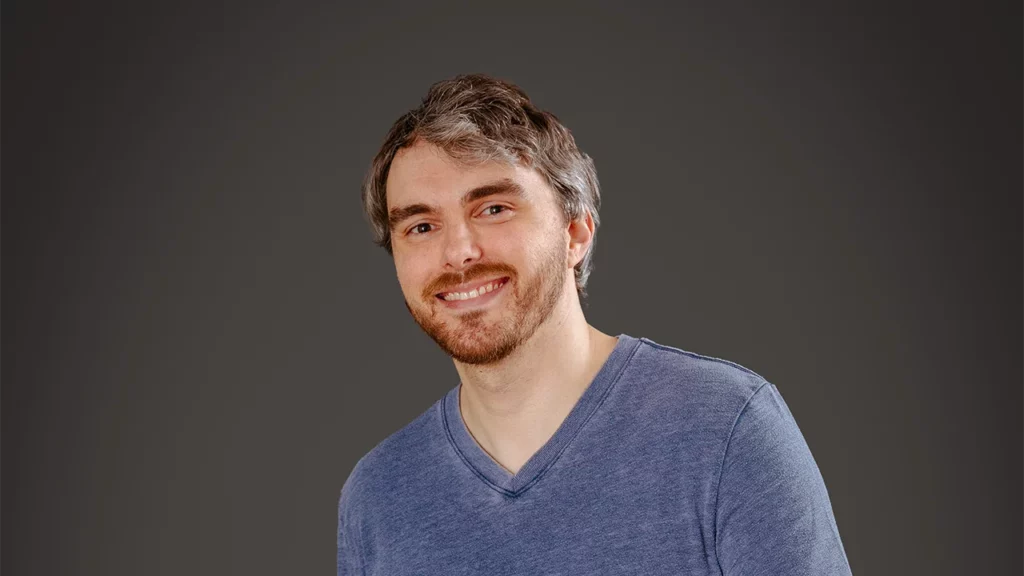
Andrew Clayton, aka Atropos, is the founding developer and leader of the team behind Foundry Virtual Tabletop. He went live with development back in 2018 (your intrepid writer was there from version 0.22; yes, I regularly feel old now); although it’s worth noting Andrew was building off plenty of experience with creating community platforms with tabletop-adjacent gaming groups; he was the founder of Tamriel Foundry for Elder Scrolls Online players back in 2012.
In 2018, the VTT landscape really only had Roll20 (free, but buggy) and Fantasy Grounds (comprehensive, but expensive). Dissatisfied with those choices, and far from being the only one, Andrew built his own.
Eight years later (and 11,457 features added/bugs crushed to date), Foundry VTT is one of the industry’s Big Three. It has a friendly community topping 110,000 members; there are 475 approved gaming systems ranging from D&D 5.5 to LANCER, The Alien RPG to GURPS; and the modding community has an incredible—borderline crazy—5,338 approved mods to add to the experience.
It’s safe to say the Foundry scene is thriving and shows no signs of stopping.
Andrew Clayton (Atropos) on 8 Incredible Years
Firstly Andrew, a big thank you for wanting to do this interview. Also, huge congratulations to you and the team; reaching Version 14 and Scene Levels fulfills the original vision for the software way back in 2018! Are there any standout memories for when you realised Foundry had become a major success?
Along this surreal journey there have definitely been a number of moments where we could zoom out a little and really appreciate the satisfaction of seeing things working as we had hoped. Seeing an early-supporting Patreon community come together who were willing to encourage creation of the software in the first place was probably the first moment like that.
Establishing an early content partnership with Cubicle 7 was crazy to think that we had licensed Warhammer content on our platform–one of the most immense gaming brands in the world. Being able to deliver some major generational releases that redesigned key parts of the software in a way that made them structurally sound for the long term–in hindsight releases that were a little painful for everyone, but they proved that we could own what we created and not be overcome by its initial limitations.
In recent years, meeting with our vast community of users and fans each year at PAX Unplugged and hearing their stories about the software. These are all moments that make me feel that wow, the appreciation and gratitude to be able to do this and to have Foundry VTT be a success. I’m very proud of what I’ve accomplished–along with a tremendous team.
On Foundry’s Community
One of the central pillars for Foundry’s meteoric rise has been the community. A feature that personally won me over was the one-off payment. In an age when subscriptions seem to be the only model companies want to adopt, has Foundry’s strength and resilience surprised you?
Yes, it has surprised me, although it wasn’t something I thought was impossible. I knew that there would be a lot of people out there who could really appreciate the features that Foundry VTT was going to deliver.
As a one-time-purchase model, however, I also believed that the population of customers would probably dwindle and force us to rely on alternative revenue streams or secondary products in order to keep things going. What has amazed me is just how big the TTRPG community is these days. There are just so many people out there who are interested in trying out tabletop gaming, and so many of them who are interested in taking those games online.
So, yes, it has been surprising in the best way that the core business proposition of Foundry VTT is one that keeps attracting new people so that I can keep our team together and keep pursuing our long-term vision.
The modding community has been another major cause of celebration. From weather calendars and stock exchange trackers to fully 3D canvas conversions, the range and dedication are incredible. Are there any mods that shocked you over what Foundry can do?
I don’t think I would say “shocked”, because the main motivation for building Foundry VTT in a stack with familiar web development paradigms and an open Javascript API was that I knew how flexible and how powerful it could be for a huge range of creative ideas. I have routinely been impressed at how creative and talented our module developers are in executing on their ideas.
On Building Crucible, An Original RPG
Crucible is your own RPG system, built exclusively for Foundry. You’ve somehow found the time to develop it alongside the Foundry VTT. How does creating a game system compare to building a virtual tabletop for gaming?
In some ways, working on Crucible feels very similar to working on Foundry VTT itself, it’s the same environment, the same API, the same key concepts. It, of course, takes a different mindset and I spend a lot more time thinking about game mechanics rather than just foundational support for those mechanics.
It often shifts my viewpoint into that of a creator and gives me a different perspective on the things that Foundry VTT does well or poorly as a platform. I am privileged in my ability to translate those insights generated during Crucible development into realized improvements in the Foundry VTT core.
A VTT-First Framework
One of the things that makes Crucible unique in the TTRPG space is you’ve designed it from the ground-up to utilise the strengths of a VTT. Is there a feature or mechanic in Crucible that couldn’t exist [at least without extreme difficulty] in a pen-and-paper game?
A great many of them fit this requirement I think. Some notable examples would be the microgrid (1ft grid) for highly granular movement and measurement mechanics. Mechanics that deal with positioning and movement like knockbacks, falling, charges, and pulls. A class-less talent tree that allows you to compose your character from hundreds of component options.
Also, some of the rules that are friendly because they are automated but would create friction in physical play, for example randomized determination of physical defense outcomes like dodges, blocks, or parries in response to failed attacks. Perception mechanics, for example “Blood Sense” or “Thermal Vision” where creatures can detect others using asymmetric senses.
These are just a few examples, honestly the game system is full of many more. It’s really unique and I think it takes advantage of the best things that a digital game can do. I’m really proud to be making it and I encourage folks to check it out!
On Building the World of Ember
Not only have the team been building a VTT and game system, you’re also creating a new setting called Ember. The KickStarter to launch this new world enabled Foundry to bring on a team of creatives. How have you managed to keep the vision consistent while at the same time ensuring fresh ideas keep flowing?
I’m deeply reliant on our incredible team for Ember. We have a wonderful group of full-time artists, writers, and our creative director Caeora who leads the creation of Ember’s lore and ensures that everything we create is consistent and beautiful. I work on Ember a lot myself, especially on the technical side, but I think the stability of our creative team making Ember is what has allowed us to maintain and deliver on the vision of the Kickstarter.
The fact that we have a full-time team rather than a scattered assembly of contractors makes a huge difference. We still have a long way to go to fully deliver Ember, but what we’ve made is incredible and it keeps getting better with every new update.
Andrew on Working with Giants
The Foundry team have official partnerships with Paizo and Wizards of the Coast. Daggerheart, Cosmere RPG, and Draw Steel are among others to also have support. Has attracting and maintaining these partnerships affected development of the VTT?
Certainly it has, because I end up spending a good amount of my time working with creators to establish new business development ventures and to empower them to get their content onto Foundry VTT one way or another.
Crucially, however, we only make some of this content ourselves first-party. Most of this work is created by publishers themselves either in-house or working with specialized content developers who create products for them on a contract basis. Since we have designed our premium content ecosystem in a way that empowers creators to make their own content for Foundry VTT–it lets us stay focused on making the software better without becoming totally overwhelmed by the responsibility to create thousands of pieces of content.
The fact that we have so many creators making content for Foundry VTT now, though, has absolutely changed the way that we think about developing the software. We’re certainly being more cautious these days in terms of what we change, while the first 5 years of Foundry VTT were a period of rapid growth and big changes – we’re now in a second era for the software that focuses more on stability and incremental improvements.
On AI in the Hobby
You’ve been unusually blunt about generative AI, calling its use a betrayal of the people who built this industry. Foundry’s own policy bans any AI from prepared material. Larger companies seem far less worried given the prospect of cutting costs. How do you see this playing out across the wider TTRPG hobby over the coming years?
I’m in an interesting position as both a creative person but also as a tech person. I’ve tried to hold a very firm line against AI in creative spaces and capacities where it displaces the human storytelling and creative passion that makes tabletop RPGs special in the first place. I cannot dispute, however, the enormous value these models can provide in technical spaces, and I think that on the technical side that generative AI is less of an existential threat to the purity and tradition of our hobby.
Our AI Content Policy for Foundry VTT captures this difference as well as we were able to articulate it–disallowing generative AI for user-facing game content, but allowing models to assist with software code and other tasks that support the creator. As far as how I see it play out in the coming years–I think that the potency of generative AI will continue to erode and change the definition of what it means to be a creative person. I hope that the tabletop RPG community can hold the line for a few more years and continue to prize human-created game content, but I also think that we are looking at an irresistible force and we can’t ever go back.
Looking to the Future
V14 is on record as one of the least-disruptive major upgrades yet. With stability the current target (as opposed to the rapid changes of earlier years), is V15’s likely focus improving performance? Or, do you foresee some big features still to come? (Like deeper cards integration, he says pleadingly. I kid, I kid!)
We’ll be talking more about Version 15 soon, but I do think performance will be one area of focus. We’ll also be focused on smoothing out some of the areas of the software where the UX or range of functionality is still most limited.
The example you spotlight with cards integration and support is a keen one. This is definitely on the list of areas where the implementation we have falls short of the robustness and completeness of other areas of the software. I suppose one way to think about V15 is that we’ll probably be looking to raise the floor more than raise the ceiling with regards to what the software can do.
The MGS Loot Haul Grows…
MGS is building a treasure chest of d100 random loot. What useless magic item or cursed relic would you like to add?
A magically scented candle that produces the smell of a cherished memory from someone else’s childhood.
A massive thank you to Andrew for taking the time to do this interview. Having been watching from a spectator’s seat since 2018, it’s been a personal pleasure to see Foundry, the team, and the very enthusiastic community grow and grow. In an industry increasingly tempted by shortcuts, it’s lovely to see a platform this influential built on passion and care. I’m looking forward to V15 and beyond; here’s to another 8 years of success!
How to Get into Foundry VTT
Andrew and the team are constantly working to improve the experience Foundry offers. The GitHub is a standing testament to their progress, as well as giving glimpses into what’s in the works for future development.
To dive deeper, the website is an obvious place to start; however, the Discord (with its active, welcoming, and very helpful community) and the YouTube channel (lots of how-to videos and update overviews) are also worth checking out. Also included below are the main pages for the original setting Ember and the unique Crucible RPG system. They’re definitely worth checking out!
— The Foundry Website: Foundry VTT
— Discord: Foundry’s Discord
— YouTube: The Foundry Channel
— For more information on Ember: Ember’s Main Page
— For more information on Crucible: Crucible’s Main Page
The MGS Loot Chest Thus Far
- Bag of the Lost Left Socks – Seth Skorkowsky
- Buzzing Brooch – Bob World Builder
- Poison Pen – Professor DM
- Glasses of the Horned Lizard – James Introcaso
- Candle of Vicarious Comfort – Andrew Clayton (Atropos)


