


The party finds eight pieces of [fictional metal]. The metal is very valuable, the GM tells the players. Everyone wants it; merchants will pay huge amounts for it. Unfortunately, no one explains why it’s valuable. And then the bigger error: the metal is of no special use to the player characters. It doesn’t matter how clever or cool the worldbuilding is if the GM doesn’t make the materials matter to the players.
Why should they internalise the exposition? Why are they taking a brain tax to do so? If GMs are going to introduce an original resource, and I recommend they do, it needs to serve two functions. The material needs to be useful to the world, and it needs to be useful to the players. These functions should reinforce each other, not fight against one another. Making resources matter should be both a worldbuilding opportunity, and a chance to empower characters and the narrative.
Making Resources Matter: Initial Concept
Before considering how expensive, magical, or prestigious a material is, the first question should be: what problem does it solve? Communication, transportation, construction, protection, weapon and tool creation, their maintenance, medicine, food, and fuel can all provide challenges for locals.
The reason why NPCs care about an original material should be understandable at a glance. Ideally, the material helps with a concrete need. “Wizards need it to cast spells,” is okay. “Wizards need it to maintain the spell wall protecting the town from demons” is much better; the need is concrete and has an emotional charge to it—fear and desperation. Consequently, NPC concerns feel natural.
Because the NPCs have an active need, adventure seeds and plot hooks arise organically. This encourages GMs to combine authentic-feeling worldbuilding with player engagement. Logistical gaps are opportunities for player characters to answer the call to action beyond motivations of greed. If they have a personal interest in the material for advancement or item creation, even better.
Poor Gold
Resources with world value but no player value are forgettable. Consider gold in many D&D settings. Gold has no immediate use to the player beyond buying supplies and gear. Not a critical error by itself, but then most adventurers will find enough items—often of better quality—out on quests. This is on top of any actual gold the characters find. They’re accruing one resource whose primary purpose is to get items already available from adventuring. The game loop undercuts the resource’s value.
Sure, you could argue having the gold to buy whatever the player wants would restore its importance. However, I’ve never heard of a GM who has given players this level of freedom and it gone well. Merchants have curated shopping lists. There might be a few things the players want, but not the entire magic item catalogue to exploit.
Additionally, finding gear through exploration or a tough fight is a lot more satisfying than just buying it. And that’s good—we want players motivated to go on dangerous adventures. But again, the game loop works to lessen the value of gold.
As characters go through the levels, the need to hoard their own gold evaporates. This is partly because questing often gives better rewards, so why spend the money on gear? It’s also because there are only a few interesting ways to use gold. With the majority of tables not bothering with encumbrance, high level PCs can have enough to mortgage a town in their back-pocket.
Making Resources Matter To The Game Loop
It’s not enough for NPCs to care about a material. If GMs really want players to care about a resource, it helps when it affects their character sheet. You can see this with the earliest D&D editions and modern OSR-adjacent systems like Kelsey Dionne’s Shadowdark and MCDM’s Crows. They directly connect gold with leveling up.
In Shadowdark, gold is needed to go carousing. Carousing gives, amongst other things, experience points. The carousing table is a d8 that goes from 1 to 14+. Spending gold gives the die roll a bonus; so, the only way to guarantee decent results and have chances of higher rewards is to spend more money. If players want to level up, they need more gold—advisable as level 0-3 characters are very squishy.
Crows takes a different approach with a similar outcome. Instead of carousing, players can spend resources to invest in the town. This unlocks new facilities and building functions, which in turn unlocks new buffs, gear, and other bonuses. This makes the next delve easier—in theory(!)—and encourages players to care about the town. A stronger town means a stronger, and better equipped, party.
As an aside, it’s worth highlighting both Shadowdark and Crows have limited slot-based inventory systems. This keeps bookkeeping very light weight while ensuring players have interesting choices to make. Do they take more gold for that level up, or the extra healing potion or utility item? Do they prioritise long-term survival or short-? I’m not a fan of painstakingly accurate inventory systems; so, by keeping it fast and intuitive, while still forcing important mechanical and narrative decisions, is brilliant design to me.
Making Materials Matter Even More
In a sense, tying a resource to leveling up is a simple way of making players care. Resources affecting characters’ action economies takes things to another level. Ghost rock in Pinnacle’s Weird Western Deadlands and warpstone—or wyrdstone—in Warhammer Fantasy Roleplay (WFRP) are such materials.
Ghost rock is a mineral with the captured souls of evil people inside. When burned, ghost rock releases incredible heat—along with horrifying screams—that is fantastic for incredible gadgets and designs. It is also possible to make it into very powerful ammunition, weapons, and ghostfire grenades.
As well as these uses in crafting, characters can also consume ghost rock (in powder form). This grants a big power surge at the risk of a dangerous reaction.This means players always have the choice to get a major boost as long as they have ghost rock in their inventory. Whether as a panic button in a tough situation, an evocative narrative beat, or just funsies, they can power surge; (kamenameha: not that one, this one). So long as they are ready to accept the consequences, that is.
In theory, there are trade-offs to frequent usage. Aside from the moral implications, those exposed ghost rock long-term—miners and mad scientists mainly—can get rock fever. This can make them go mad[der] or even spontaneously combust. However, there are no rules for this and the rulebook states characters can develop immunity to it. Basically, it only has problems if the table want it to.
WFRP Warpstone’s Mechanical Teeth
There’s no such mercy in WFRP. Warpstone is raw Chaos energy—pure magic in solid form. Its primary source are meteorites that have broken off from the evil moon Morrslieb. The moon appears in the sky randomly, with its chilling green glow.
Instead of Deadlands’ soft approach, WFRP comes with a fully developed subsystem. Characters exposed to warpstone gain Corruption points. Once their Corruption goes past their Willpower and Toughness bonuses, they take a test. Fail, and their body mutates. This can be mental—paranoia, hearing voices—or physical—tentacles, clawed hands, cloven feet. Such marks of Chaos turn locals fearful or openly hostile to the PC, and attract the attentions of witch hunters. Mutate enough times and the character risks becoming a Chaos Spawn: a mindless, horrifying beast.
In fact, warpstone actually has many names: “seer stone,” “foulstone,” “witch stone,” “mage gold,” and “god stone.” These hint at both the power and danger on offer should players pursue it.
Don’t Go Too Hard Trying to Make Materials Matter
Firstly, notice the massive jump in worldbuilding for both ghost rock and warpstone versus gold in Shadowdark and Crows. That doesn’t make gold a bad choice for those games; however, the worlds of Deadlands andWFRP get a definite boost in the worldbuilding department.
Secondly, both ghost rock and especially warpstone have danger attached to them. I would bet it’s no coincidence the designers made interaction with it largely optional. Some players love Devil’s Bargains. Others hate them. PCs have the choice to pursue power—hopefully aware of the risks—or they can try to avoid it. GMs shouldn’t be bullying players into taking on risks they don’t find fun.
Lastly, the power on offer is great, but both systems try to avoid making the drawbacks too punishing; if the penalties are too sudden and/or severe, very few players will be tempted. Where the balance is between worthy risks and rewards will vary from person to person. Whether it suits your table rests on a fundamental rule of a happy table: Know Your Group.
Making Materials Matter Means Different Things To Different People
This is often what separates basic materials from really memorable ones. If every NPC sees the material in the same way, it flattens the world. Looking back at warpstone, think about the implications of one group calling it “foulstone” versus one calling it “god stone;” likewise, “mage gold” hints at a different perspective to “witch stone.”
To one group or culture, the material may be a valuable building resource; it may be sacred or useful for medicine. Other groups may see it as fuel for weapons, or an obstacle that needs destroying. Importantly, this isn’t a good versus bad world-view. Each group’s perspective has justification according to their position and beliefs. Not only does this conflict naturally create interesting quest ideas, it encourages a more authentic-feeling world. Perspectives are wide and varied in life; memorable worlds reflect this.
Remnite: A Working Example
I have been thinking about making materials matter a lot due to having just developed my own. Remnite is a mineral bearing the compressed essence of souls from a civilisation long dead. Though certainly inspired by Deadlands’ ghost rock, I don’t have any interest in simplifying anyone down to purely good or evil.
Remnite is its commercial name, soft-sounding and scientific. Weapons and armour made with the mineral are one of the few dependable ways to deal with the Eldritch. This growing threat is waking up across the planet, causing fear and horror across the kingdoms. Mining is dangerous; it drives the local megafauna crazy. However, business is booming: demand is fierce and competition often leads to conflict, both between suppliers and between buyers.
The mineral has other names, too. One is “shriek.” When burned, remnite—or shriek—emits a piercing noise that drives the Eldritch away. Many religious orders and doomsday cults have sensed the souls within and have come to see the sacrifice as sacred. Souls protecting souls. Shriekers view use of the mineral in weapons as a mistake. Far better, they think, to use it in rituals that will protect a community; it is a gift from their gods, offering protection.
“Anath” is another name for the material. The Eldritch have worshippers, too. These cultists abhor remnite and seek to destroy it at any opportunity. It is an affront to their masters. The Reawakening will not be denied.
Worldbuilding with Player-Gaps in Mind
So, various groups see remnite as a crafting material, sacred object, ritual ingredient, money-maker, and forbidden material. All of these perspectives are legitimate and the uses valid. Players can see the differences in motivation at a glance; rival groups readily create narrative and quest potential between them that are quickly understandable to the players. Personal use also offers opportunities directly to the PCs.
As a final flourish, I took advantage of Michael’s free app so my players can see what remnite looks like. Here is is in all its glory! (And yes, I chose green, universal colour-code for creepy magic…):
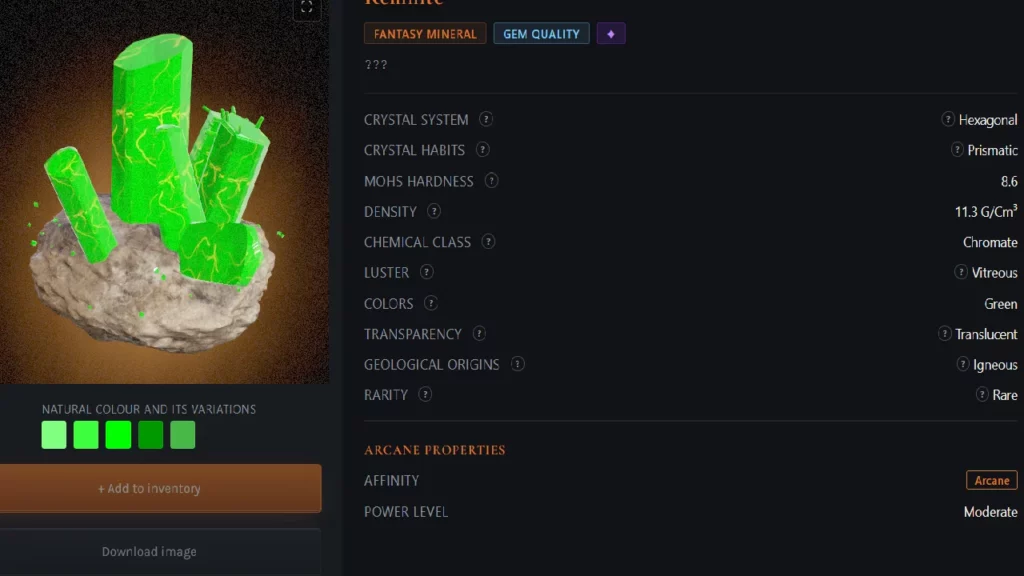
Details may change as players come into contact with remnite. I’ve deliberately made sure none of the groups have a full picture—they know many consequences but no reasons. This leaves me gaps to fill with any cool new ideas that come later.
Making Materials Matter: The Happy Few
Every original piece of worldbuilding takes a brain tax. In this article, I talked about how useful genre can be as a shortcut towards understanding. Generic resources do the same thing: they cut down on exposition and don’t cause unnecessary distractions.
Shadowdark’s priority is on real-time torches counting down to darkness. Similarly, Crows’ tension between the world’s miasma and the players’ town is central to the action. By using a basic currency, both systems stay laser-focused these elements.
GMs tend to live and breathe their world. The original pantheons, kingdoms, local and regional politics, even economics, including original materials, are fresh in the mind. I think it’s pretty safe to say this is not the case for the vast majority of players. Frequently, they don’t have the whole picture. Often, they’re understandably hyper-focused on their one character’s experience. Every non-genre conforming, non-generic element takes a mental tax.
I said during creation the first question GMs should ask is “what problem does this original resource solve?” In fact, the most important question above everything is “does the resource bring enough opportunities for the players to exploit?” Or, rephrased, “is it worth the trouble?”
For this reason, I recommend a world shouldn’t have more than one or two original materials. However, it’s worth considering if one is worth introducing at all. The point isn’t to make a material just because the GM thinks it’s cool. If players cannot exploit it, if it doesn’t directly add to the group’s fun, it’s better focusing attentions elsewhere.
A Design Checklist for Making Resources Matter
For materials impacting the game loop, consider:
- What problem does it solve?
- Who wants it? (Ideally more than one group)
- Why do they want it? (For legitimate but conflicting reasons)
- Who produces and distributes it?
- Who is excluded from getting or using it?
- What can the characters do with it? (Beyond just selling or using it as currency)
- Lastly, and most importantly, does this resource give players enough mechanical and/or narrative opportunities to exploit to justify it?
Conclusion
Creating original materials is one of the common building blocks of worldbuilding. We can see it everywhere, from Tolkien’s mithril, to Herbert’s spice melange, to Warhammer’s warpstone, and Marvel’s adamantium. But each of these elevates the world because they solve real problems—and cause them, too, actually. However, original materials in a RPG need to be crafted with extra care. Because we are playing a game, very often involving other people, it has to do more than satisfy creative fancy. It has to serve the group. Making materials matter means making sure they open up both narrative and mechanical opportunities. Worldbuilders must make sure the juice is worth the squeeze for everyone at the table.


